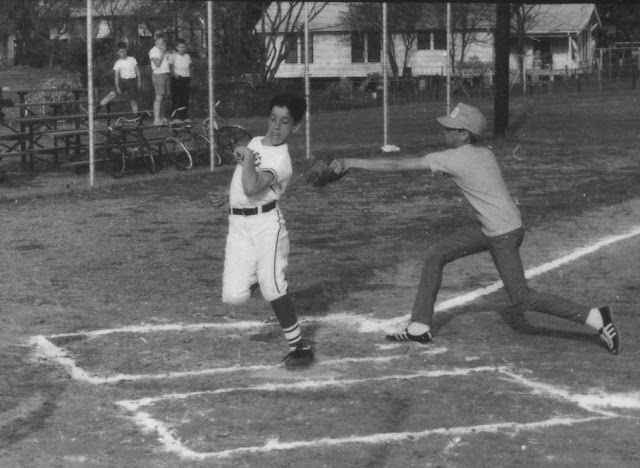
Friday, December 25, 2009

Remembering Christmas Past


When John, David, Tommy and Mary Marshall were very young, each year on the first Sunday in Advent, Jack Marshall would try to set the proper tone for the upcoming Christmas season.

"Stir up thy power, we beseech thee oh Lord, and come!" he would read with his most fervent Catholic voice, while John, the oldest, enjoyed the privilege of lighting the first candle on our homemade Advent wreath as we sat down to our Sunday meal.

The process was repeated with the appropriate reading for each Sunday in Advent. Then the candle-lighting privilege passed down through the birth order, so that David was accorded the honor on the second Sunday, then me on the third, and finally little Mary, usually with some help from Mom, lit all four candles in the final days before Christmas.

For a while it worked.

All of us spent the weeks watching as Dad added little creatures to his homemade nativity scene. The manger remained empty, though, until Christmas morning, when a tiny little plastic baby Jesus appeared as if by magic.

But despite Jack Marshall's best efforts, the weeks leading up the big day in the Marshall household inevitably and steadily devolved into a frenzy of gift buying, tree trimming and house decorating.

It started perhaps with the famous Christmas Festival just down Highway 1 in tiny Natchitoches, LA, where our St. Joseph's band sometimes marched in the annual parade on the first weekend in December. (The festival was made even more famous years later when it was portrayed in the movie "Steel Magnolias.") The same parade where Jack Marshall snapped the photo, below, of "Miss Christmas Festival" on December 5, 1959, as she proudly waved to the crowd in front of the Piggly Wiggly store.


It continued when we finally persuaded Dad it was time to buy and trim the Christmas tree.

Buying a tree always was a big deal to Jack Marshall. The whole family would pile into our '52 Chevy (nicknamed "The Metal Monster" by my older brothers) and drive to the big tree sale lot run by the Optimist Club near the corner of Youree Drive and Kings Highway. I imagine that when the tree salesmen saw our big crew unload, they all suddenly wanted to take a break and duck into Murrell's Grill for a cup of hot coffee. Because each of us had a different -- and strong -- opinion about which tree was best.

After careful inspection of every tree on the lot, and mindful of Dad's budget restrictions ("Nothing over $10 kids"), a tree was selected and ceremoniously tied to the roof of The Metal Monster using an intricate series of slip knots that my father proudly demonstrated to us. Then we drove home with our prized possession blowing in the wind above us, like the carcass of a giant moose that was going to feed the family for the winter.

Once home, the fun turned serious.

First, Dad, John and David were charged with putting the tree into the stand and getting it straight. This usually took only an hour or two, while Mom, Mary and I were unboxing the rest of the decorations and checking the lights. For some reason, Christmas tree lights mysteriously ceased to operate during their summer in the scorching hot attics of Louisiana. After several trips to the TG&Y store for spare bulbs and working extension cords, the tree was lit and decorated with ornaments.

And then, the much anticipated final glorious ultimate level of decoration: tinsel.

Each of us was given a carefully tied bundle of tinsel from last year's tree, which my father had carefully saved. (Others families inexplicably discarded their trees each year after Christmas with most of the tinsel still tangled in the branches, but not the Marshalls!) And we were reminded vigrously that for the most realistic effect, each and every strand of tinsel must, repeat MUST, be hung carefully and individually from the limbs of the tree. Dad ceremoniously demonstrated the proper technique, and then retreated to one corner of the room to watch his young charges follow his careful orders.

John was exacting and perfect in following the guidelines (he is now an accountant by the way). David, being tall, always did a great job at the top of the tree. Which left the bottom branches to Mary and me.

Let's just say that's where Jack Marshall's plan usually went awry.

I promise, I tried to follow Dad's instructions. And I actually did for the first few minutes. But my young attention span was not focused enough for the task and soon I was sneaking two or three strands at a time onto the limbs. And almost from the start, Mary believed the tinsel was just plain fun, and should be twirled, spun, waved and ultimately tossed in huge unruly chunks anywhere and everywhere on the tree.

In her defense, Mary had more fun than the rest of us put together. And, I believe, Jack Marshall had fun watching her too, as you can see by his photo at the end of the article, taken in December of 1958.

With the tree decorated, it was time for one last photo, top, before the presents began to fill the space underneath. And then began the countdown to Christmas Day itself, when all those wonderful presents provided the Marshall kids with a fitting end to the holy season of Advent.

Wherever you are this morning, I hope you are with family, sharing the wonder and magic of Christmas. I am in Shreveport at Mary's home, and her expertly trimmed tree is a perfect centerpiece to this happy day. Somewhere in heaven, I am certain that Jack Marshall is enjoying his fragrant fir with real icicles hanging gloriously and perfectly from each branch.

Merry Christmas everyone!


–Tom Marshall, New York City
on Christmas Day 2009 in Shreveport

Sunday, December 20, 2009

Christmas Shopping at the TG&Y


As we officially approach the end of the annual Christmas shopping season, I am finding special inspiration in some of Jack Marshall's classic holiday photographs.

When I was a kid, Christmas shopping was easy. You saved your allowance, supplemented it with income from odd chores and perhaps a little parental largesse, and a few days before December 25 you headed to the TG&Y Store and knocked it all out in less than an hour. No muss, no fuss.

What's that you say? You haven't heard of the TG&Y Store? Well, let me tell you...

Long before the big Shreve Memorial Library that now occupies the site off Kings Highway between Patton and Preston just east of the bayou in Shreveport, there was an outdoor movie house called King's Drive-In Theatre. In the mid- to late-1950s, the theater closed and the state-of-the-art Shreve Island Shopping Center opened in its place.

It was the newest idea around, something totally revolutionary, called a strip mall.

The center featured a big A&P supermarket (relocated from near Centenary College), a small department store called Beall's, the Shreve Island Drug store (which featured 5¢ cherry Cokes at the soda fountain), a dress shop called Sa-Ru's Fashions, a barber shop (75¢, four chairs, no waiting), a dry cleaners and the greatest thing ever to hit our end of town, the TG&Y.

TG&Y was sort of like Walmart, only smaller and cheaper.

Back then I had no idea what TG&Y stood for. The kids in the neighborhood concocted a slogan that went something like, "Take It, Grab It, and Yell" for how we felt when we went shopping there. Jack Marshall liked to call it "T-Gyp-and-Y." The chain's slogan was "Your best buy is at TG&Y."

(The all-knowing Wikipedia now tells me that TG&Y actually represented the last names of the store's three founders – Tomlinson, Gosselin and Young. The chain was based in Oklahoma City and at its peak boasted more than 900 stores. After a series of sales and consolidations, the last vestiges of TG&Y went out of business in 2001.)

My brothers John and David and sister Mary and I did all our Christmas shopping there. We also hoped Santa was smart enough to shop there too, because it seemed to us that the store had everything we wanted. Mary had her eye on a Chatty Cathy doll, and I was a big fan of coin collecting and model airplanes. Lucky for us, TG&Y was just the place to find such things.

In Jack Marshall's photographs, you can see mannequins (top of post) sporting the latest scarves for Mom, Mary and I reaching for our dreams (above), Mary enjoying the Chatty Cathy display (below), and finally, Mary counting her pennies to see if it all adds up (end of post).


I fear I am starting to sound like –no, I fear I am becoming – an old fogey who too fondly remembers times past. But I make no apology for happy memories of walking into that TG&Y a few days before Christmas with considerably less than $10 in your pocket and buying something for everyone on your shopping list, with enough left over for a bag full of Hershey's Kisses to give you strength for the bike ride home.

For some reason, I especially remember a framed painting I bought one year at TG&Y for my grandmother, my father's mother whom we called "Muds." It was a mountain scene and I thought it was beautiful, and I hoped fervently that Muds would appreciate it, for she was an accomplished oil painter herself. I recall that the painting, frame and all, cost 79 cents. I remember the delight on my grandmother's face when she unwrapped the present on Christmas Eve, as we all gathered to open the non-Santa presents before going to Midnight Mass at St. Joseph's.

But what I especially remember is that for the next 20 or so years, that 79¢ painting hung on the wall of Muds's little house on Rutherford Street and then in the nursing home where she spent her last years, proudly displayed among her truly beautiful oil paintings.

Because for 79 cents at the TG&Y, you surely could show your grandmother how much you loved her.

Here's to your own successful last-minute Christmas shopping!


– Tom Marshall, New York City

Thursday, December 10, 2009

My Friend Tommy Wall


A long time ago, I had a friend named Tommy Wall.

In Jack Marshall's photograph, above, taken in the summer of 1963, my friend Tommy Wall is standing confidently in the back row, second from the left, with his hat cocked just so. Tommy Marshall is the one just in front of him, leaning in to hold the bat with my right hand. We were playing for our first baseball team, in the South Shreveport YMCA. I recall we chose the name "Tigers" for our team that long-ago season. We were 9 years old.

Tommy Wall lived on the same street as I did, just a couple of blocks away. Tommy was his family's only son; he had 5 sisters. From kindergarten through eighth grade, we played together on all the same sports teams. Usually we played for teams sponsored by St. Joseph's Catholic Church. We played football in the fall, basketball in the winter, and baseball in the spring and summer. When we were kids, there was a perfect symmetry to the seasons of sport, because those three were the only pursuits available to us. There was no such thing as soccer or lacrosse or any of the other more exotic sports that kids play today.

In our corner of Shreveport, Tommy Wall almost always was the best athlete on our teams. And even when he was challenged for athletic superiority -- which was rare -- Tommy Wall was our undisputed leader. It was never questioned. He just led us, and we followed.

Chances are you knew someone like Tommy Wall.

Have you ever seen the Disney movie, "The Sandlot"? It's about a group of boys who spend an early 1960s summer playing baseball together. Tommy Wall reminds me of the Benny "The Jet" Rodriguez character in that movie, the kid who is the fastest and best athlete on the team, and also the undisputed leader of the group.

At St. Joe's, whenever the nuns let us troop outside for recess, Tommy Wall was the kid who was organizing a game of some sort. Choosing up sides and playing whatever sport was in season.

All these years later, the most amazing thing I remember about Tommy is not how well he played the games of our youth. Instead I remember him most for a certain innate skill he had from the earliest age of being that game organizer, and more importantly, the one who made sure everyone was included, and that the teams were fair.

Tommy Wall was the one who switched teams to even up the competition. Or who played catcher for both teams when no one else wanted the job. Or who coaxed the shy or unsure kid from the sidelines into the game.

I was that kid on the sidelines once. Though never shy (ask my family and friends about that), I never was a very confident athlete. I played on all the teams, and I had a great time with sports, but I just didn't feel I had the same skills as many of the other kids.

That didn't matter to Tommy Wall.

He wanted everyone to play, and in a prescience beyond his years, I believe he understood that we were better as a team than he ever could be as an individual player.

The most special thing that Tommy Wall ever did for me happened at recess one day at St. Joseph's, during our third grade year. We were playing baseball, and Tommy was the catcher for both teams. Since it wasn't an official practice there was no real equipment, just a baseball and a bat someone had brought from home. And no protective gear for the catcher.

When it was my turn to bat, a kid named Danny Brooks was pitching. Danny wound up and threw a fast, hard pitch, right down the middle. I closed my eyes, took a mighty swing and hit a foul tip that changed the ball's course just enough so that Tommy Wall was not able to catch it in his glove. Instead, the ball plunked loudly into his ribs, and he rolled onto the ground in obvious pain.

Everyone gathered around, waiting to see how badly he was hurt, what he would say, what he would do. I was in the crowd, half expecting him to come up ready for a fight. After all, I had injured the great Tommy Wall! Slowly he rolled over, grimacing from the pain. And then he said words I'll never forget: "That's all right, a lot of batters do that." The best athlete in the school had just saved my life, I thought, and on top of that, he had called me a "batter." On that day, Tommy Wall set for me an example of leadership and fairness among peers that never would be surpassed. I felt I owed him a debt I never repaid.

Throughout our elementary years, our St. Joe's teams won and lost games, but due to the skill of Tommy Wall and several other good young athletes, we won far more than we lost.

In the middle picture above, Jack Marshall's camera caught Tommy Wall scoring a run in a seventh-grade baseball game in 1967. Immediately below is our 6th grade football team, in November 1965. Tommy Wall is in the front row, No. 18, our quarterback. The picture at the bottom of this post is our 5th grade basketball team, celebrating one of several city championships. If you don't recognize him by now, Tommy is 3rd from the right in the front, smiling and reaching out to touch our plaque.

After St. Joseph's, I went on to Jesuit High School, and Tommy Wall went to a different high school. Somewhere over the next few years, we lost touch as we finished high school and enrolled in college.

For my freshman year in college, I lived at home and went to Centenary College, where Jack Marshall received his education. Tommy, like so many other young Shreveporters, headed down to Baton Rouge for college at LSU. One weekend during the fall of that 1972 freshman year, on an infamously treacherous road between Shreveport and Baton Rouge, Tommy Wall was tragically killed in an automobile accident. I never got a chance to thank him for how he treated me on that 3rd grade playground.

Because of the memories inspired by Jack Marshall's photographs of our glory days at St. Joseph's, today my sister Mary and I went for a run on a chilly, breezy morning in Shreveport. Our route took us to Forest Park Cemetery, where we found the shaded gravesite of a boy who died too young, just 18 years old, on September 14, 1972. We wiped away the fallen leaves from the small marker, and when I saw the name Thomas Charles Wall, Jr. etched in the cold, hard stone, it brought tears to my eyes. Tears I never shed for a friend to whom I never said goodbye.

So today, finally, I stood quietly for a moment and said goodbye to my boyhood friend Tommy Wall. And, most importantly, I whispered a silent prayer of simple thanks, remembering a wonderful act of genuine sportsmanship bestowed upon me nearly 50 years ago by a young athlete and forever friend. And for which, to this day, I remain grateful.

--Tom Marshall, New York City
Written while visiting Shreveport

Thursday, November 26, 2009

Thanksgiving at the Marshalls


Over the years, what stands out in my memories of our family Thanksgiving dinners is that they were remarkable for their lack of drama.

In the years before Martha Stewart made everyone feel guilty for not creating memorably lavish gastronomic triumphs, Jack and Giffy Marshall did a pretty good job of creating memories for me with the small core group of regulars who each year came to our house on Audubon Place in Shreveport to give simple thanks.

In my recollection, there was nothing outrageous enough to make into a movie, or even into a sitcom script. No breathtaking revelations from family members, no drunken brawls amongst aunts and uncles, no unruly dogs eating the turkey from the kitchen counter. Nothing but good food and a larger than normal group around the table.

Don't get me wrong though. Thanksgiving at the Marshalls always was a special day, and I looked forward to it as a highlight of each year of my young life.

First was the food itself. Not so much the quality -- although our mother was an excellent cook -- but the quantity. The Marshalls were neither poor nor rich. But, on the 364 regular days of the year, there were limits imposed on what we could eat and drink. ONE slice of bacon and ONE glass of orange juice at breakfast. (There was a lot of bartering, however, between siblings.) Lots of spaghetti and casseroles. Salmon croquettes or fish sticks on Friday. Roast beef with rice and gravy once a week, on Sunday. Few snack foods or desserts.

Thanksgiving was just the opposite. There was a full and diverse menu from which to choose and plenty of everything!

Most memorably, we ate in the dining room, not the kitchen. Mom and Dad made a big deal out of putting the large oval top on the dining room table, which made it big enough for 12 or more. If the crowd was particularly large, a series of card tables was attached from the bottom of the oval, and stretched into the living room area. Thanksgiving was the one meal a year when we ate off the "good china" with the "real silverware." And thanks to Land O'Lakes and the A&P Supermarket, there always was "real butter" too -- an unheard-of treat!

Another thing that was special about Thanksgiving to me was that there usually was no
kids table. My sister Mary says Giffy wanted it that way, for everyone to sit together. I always liked that. Even when I was small, I remember sitting with the grown-ups and listening to grown-up talk, about President Kennedy, maybe, or the new Pope who had changed the rules regarding fasting before communion, or whether Navy could beat Army in the week's big game. My mother's mother, Mere, had a favorite expression from growing up in a large, multi-generational, French-speaking home. "Let only six talk at a time," Mere would say, and at our Thanksgiving table, that often was the case.

When all was ready, Jack Marshall would begin the blessing. Nowadays, we usually improvise, with one person or everyone giving specific thanks for the many blessings in our lives. Back then, Dad's leadership was limited to saying the familiar first words, "Bless us oh Lord..." and then we'd all join in, "and these thy gifts, which we are about to receive from thy bounty, through Christ our Lord. Amen." It was the same blessing we said every day, for every meal, but on Thanksgiving, we recited those well-known words with special fervor. For on that day, the word "bounty" really meant something.

The pictures with this post were taken 39 years ago today, on Thursday, November 26, 1970. When I saw the date noted on the back of Jack Marshall's contact sheet, I was amazed that Thanksgiving fell on the same date, November 26, as it does this year. I checked an online calendar to make sure it was true!

Before the meal, everyone trooped out front for Dad to take our picture: Mom, my brother John, and my sister Mary, with only brother David missing; Mere, and my father's mother, Catherine; my father's sister Doris and her husband Harry (in his Navy uniform), along with their daughter Patty and her husband Bill, and Catherine's sister, Blanche. I believe I took the other picture, of Dad, just before he began carving the turkey, with a happy Mere to his right and his mother Catherine to his left. Dad always made a big show of honing the knife to its sharpest just before starting to slice.

There are so few pictures of Dad -- since he usually was the one behind the camera -- that I really love this photo. Even though he is giving me a big, cheesy pose, I think I can see the twinkle in his eye and his true joy at being surrounded by his family. He is not quite 50 years old, in the very prime of his life.

Less than 6 years later, Jack Marshall was gone.

If he were still alive today, we could be celebrating Thanksgiving dinner with a crowd including his 4 children (and spouses), 11 grandchildren -- many of them now with spouses, and even a couple of great grandchildren. There could be 30 or more around the table, and I bet Dad would still be leading us in "Bless us oh Lord" before proudly carving the turkey. I'm sorry Dad died without ever sharing that huge Thanksgiving feast. There might have to be a kids table now, and there definitely would be even more food.

And I'm very certain Jack Marshall would have taken the definitive photograph of the assembled group, because that's what he always did. He would have enjoyed this day immensely.

Today when I give thanks for the many blessings in my life, I will, as I always do, say a silent prayer of gratitude for our heroically normal, quietly loving father, Jack Marshall. For he gave us the gift of a happy, secure, wonderful family, his forever legacy to us all, a gift of infinite, inestimable value.

Happy Thanksgiving everyone!

--Tom Marshall, New York City,
Celebrating Thanksgiving 2009 in Seattle

Wednesday, November 11, 2009

Veterans Day 2009


One of my most treasured possessions is a textbook from Jack Marshall's senior year at Centenary College of Louisiana. The book, “Advertising Procedure,” sits on a shelf near my computer here in New York City. I find myself picking it up fairly often, flipping through the pages with their illustrations of what now would be considered classic advertising. For some reason, the fragile yellow pages and my father's carefully scripted margin notes always give me a strong sense of his everlasting presence in my life.

At the end of Chapter 11 in Dad's book, there is a handwritten assignment dated “12/5/41” with a notation to read certain pages by “12/8/41.” I guess as he was studying that weekend and completing that assignment, his world changed forever, because that Sunday as we all know, Pearl Harbor was attacked, and a few short months later Jack Marshall and many of his classmates were thousands of miles from home, in Europe and Asia, fighting for the freedoms we continue to enjoy as Americans today.

My father, John Wilcox Marshall Jr. (known to all as "Jack"), graduated from Centenary in May of 1942 and, barely 21 years old, immediately joined the Navy. By the summer of 1943, he was on board the USS Mullany when the destroyer was commissioned in San Francisco and steamed into World War II in the Pacific Ocean. The photo above shows Dad, by now about 22, standing second from left, and other officers on the Mullany sometime in 1943.


More than 20 years later, my oldest brother, John Wilcox Marshall III (above, at bottom of airplane steps, in a picture taken by Jack Marshall), followed his father into the Navy, serving aboard the guided missile cruiser USS Galveston during the Vietnam War. Though the circumstances of John's enlistment and the war itself were far different from our father's service, I know my brother too believed in the importance of fulfilling his duty to serve our country.

The newsman Tom Brokaw has written a book calling Jack Marshall and his contemporaries "The Greatest Generation." Not only for their service in World War II but also for their relentless hard work and optimism building America into an even greater nation in the years that followed. I have many friends whose fathers also served in World War II. Over the years, those friends and I have shared memories of our dads, and the qualities and values we know they gave our families and our lives.

The Department of Veterans Affairs estimates that about 2 million veterans of World War II still are living, but they are dying at a rate of about 1,000 per day. All are expected to be gone by 2020.

Jack Marshall came home from World War II, met and married my mother, and together they raised four children in what for me was a wonderful, happy and supportive environment. Dad was not perfect, but he loved his family and his country. My father died far too young, at the age of 55, in 1976. I still miss him every day.

On Veterans Day 2009, I want to publicly express my gratitude to my father John W. Marshall Jr., my brother John Marshall III, my nephew Andrew John Marshall (John's son, an Air Force B-52 navigation officer) and all of the men and women who ever have served or now are serving in the armed forces of the United States of America.

Thank you for your service to our country!

–Tom Marshall, New York City

Saturday, November 7, 2009

Rocky Mountains, Hi


Imagine this.

The year is 1964. Trips to Hawaii, Europe or the Caribbean – anything that requires a passport or an airplane ticket – are strictly fantasies, suitable only for the rich.

Although the revolutionary system of smooth, straight interstate highways is under construction, it is a time when cross country car trips cover many miles on old two- and four-lane highways that pass through the center of each little town along the way. Air conditioning is a relatively new option on automobiles and it is something you pay extra for in motels. Almost everyone drives an American made car; you are either a GM family or a Ford family.

So, just for fun, you load 4 children into a 1961 Buick LeSabre which nominally features air conditioning – tepid at best and tending to make the engine run hot. You put a giant canvas tent in the trunk, along with all the powdered food and canned goods you can fit. You fill the fuel tank with 20 gallons of gasoline at about 27¢ per gallon.

And then, you leave Shreveport, Louisiana, headed for the Great American West.

That's exactly what the Marshall family did for fun. Our father, Jack Marshall, thought it might be interesting, educational – and cheaper – to go on a camping vacation "out West."

Just before his 1943 World War II deployment as a U.S. Navy officer in the Pacific, Dad had for a time been stationed in San Francisco, and had fallen in love with the Western landscapes immortalized by Ansel Adams. So when the logistics and expense of beach vacations became too much for our growing family, and when we all clamored for something other than vacation trips to visit our relatives in New Orleans, Dad hatched his plan for camping.

After a couple of trial runs to Arkansas and Oklahoma, we finally were ready for our grand adventures to the West. Although this 1964 trip was the first, we ultimately took several car and camping trips to the West that gave our wide-eyed Louisiana family (and a couple of unsuspecting guests) memories of a lifetime, with stops at landmarks such as the Grand Canyon, Hoover Dam, Pikes Peak, the Air Force Academy, Rocky Mountain National Park, Garden of the Gods, the cliff dwellings at Mesa Verde, Las Vegas, Lake Mead, Death Valley and eventually even Yosemite National Park, Los Angeles, Disneyland and the Pacific Ocean.

We did it all without cruise control, cell phones or video games. And most of the time without television, air conditioning, electricity or even running water.

On the first day of that 1964 trip, as would be the case in all future trips West, we drove across Texas. Not all the way across Texas, but almost. That first-day drive of nearly 600 miles always was as far as a family of 6 in a recalcitrant, low riding, prone-to-overheating Buick could tolerate in one day. When you leave Shreveport heading west, you almost immediately cross the Texas border. Starting soon after sunrise and driving hard for 14 hours or more, we usually limped into Amarillo (or "Armadillo" as Jack Marshall insisted on calling it), long after the sun had set in a blazing wet pool on the asphalt in front of our hot, tired car full of intrepid adventurers.

Nothing ever looked as welcoming as that Best Western Motel, just off what is now referred to as "Historic Route 66," where we usually spent our first night. After a shower and the last of the sandwiches and fruit my mother had packed in Shreveport, we all fell into our beds, exhausted. And we slept well that night, knowing it was the last night for a while with artificially cool air or blessedly hot water.


Day Two always dawned with excitement. First of all, we got to eat breakfast in an actual diner. Jack Marshall used to proudly announce as we trooped in, looking like we hadn't eaten in a week, "Kids, you can have anything you want, as long as it doesn't cost more than 59 cents!" We were pretty sure he was joking, but then again, maybe not. And once, a waitress dutifully trying to clarify my mother's order for an egg, asked her, "Over easy?" To which Giffy Marshall , suspicious of any meal not prepared in her own kitchen, tersely responded, "Oh, no, not greasy!"

The second day of our trip also was exciting because it was the first day we would see the mountains. Leaving Amarillo, we headed northwest, through a corner of New Mexico. At some point, the road began to rise, and soon we were in Raton Pass, which would carry us into Colorado. The heavily loaded Buick (see above) labored to climb the hills and Dad carefully pumped the brakes as we lurched down steep inclines.

The first morning of our first camping trip to Colorado, everyone woke early. It was still dark outside, but the Eastern sky showed traces of the coming sun. My father reluctantly rose with us, and we joined some new neighbors at their campfire. As we huddled together in excitement, Dad guessed with the other father how cold it must be. Then, stifling a yawn, my Dad squinted at his watched and remarked that he couldn't remember the last time he was awake at 5:30 in the morning. Incredulous at my father's "rookie mistake," the neighbor pointed out that we were now in the Mountain Time Zone, and it was actually 4:30 a.m. Dad was horrified, but he told that story for the rest of his life.

Still, Jack Marshall the photographer was in heaven, with breathtaking landscapes in every direction. One of his favorites is at the top of this entry.

For the next two weeks, we snuggled each night into sleeping bags against the Rocky Mountain chill. We sang songs around roaring campfires. We bought blocks of ice to keep milk and eggs fresh in a cooler. We ate pancakes and bacon cooked on a Coleman stove. We drank Tang, just like the astronauts. We went on nature hikes conducted by National Park Service rangers. We looked for – but never found – arrowheads and other Native American artifacts. We drank ice-cold water from roaring creeks. We saw snow in July and mailed postcards to friends and relatives back home in Louisiana.

Our camping trips to the West were grand, glorious, memorable and happy. Without a doubt, these trips ultimately helped define who we were as a family, and who we kids became as adults.

– Tom Marshall, New York City

Saturday, October 31, 2009

The First Day of School


I have a confession to make. I haven’t been completely truthful with you about something.

When I wrote a few weeks ago about suffering through the absolute peak of my preteen geekiness, I said the worst moment was on my 10th birthday in February 1964 (“The Fishing Trip, September 28, 2009). Upon further review, I must admit I lied.

In my defense, I wrote that because I was confronted with a Jack Marshall photograph of me in a little aluminum fishing boat. My own horror at my appearance came roaring back into my consciousness when I found that picture, but it was more than mitigated by my remembrance of that wonderful day of male bonding with my Dad, which at the time I considered the greatest day of my life and still would be were it not for the birth days two-plus decades later of my own children, James and Catherine.

No, the truth is the absolute worst occurred a bit later, when as a 5th grader at St, Joseph’s Elementary School in Shreveport, I was photographed (see below) wearing glasses so thick and so hideous that even now I literally shudder when I find it necessary to gaze upon my own image. On top of that, at some point during those same years, my ears grew faster than the rest of my head. Fortunately this was long after the Disney movie “Dumbo” was popular and long before the release of the critically acclaimed “Elephant Man” film, so the worst my so-called friends could come up with was the nickname “Big Ears” or just “Ears” which I was called fairly regularly for quite a few years. (Actually, as I think about it now, some of them still call me that, though I cannot for the life of me see why).

My father, Jack Marshall, either loved his youngest son so much that he couldn’t see the deformed youngster staring at him through the viewfinder of his camera. Or more likely, he could see all too well but he was too compassionate a father (and fellow male member of the human race) to let on. Because my friends, there are lots and lots of pictures of me from that period.

One reason there are so many pictures from that time was because in addition to being Jack Marshall’s always willing portrait subjects, we the Marshall kids were subjected to certain rituals. One was the “First Day of School” picture each September. No matter how big a hurry we were to get to St. Joe’s (or Jesuit, or St. Vincent’s Academy for my sister Mary), no school year started without us stopping to pose for Dad’s traditional photograph. He tried to vary the settings, but invariably there we were on the front or back porch of our house, sometimes with a bicycle or American flag prop, sometimes waving as if we were leaving at that very moment. Jack Marshall was channeling Norman Rockwell, and he was determined to do him justice!

Actually, despite my inner and outer geek, as I look now at the “First Day of School” picture at the top of this entry, I do see some things I like. Those are real Chuck Taylors I’m wearing, which I got not so much because they were cool (they weren’t back then, but they are now) as cheap. And I do believe my backpack, with its “US” symbol, is 100% genuine Army surplus, again in the Marshall family tradition of good value. Nowadays you’d pay a premium in a second-hand store for that kind of authenticity.

But the real reason I like this photo so much is Mary. Of course she is stylish – then as now. Of course she is much more thoughtfully coiffed and attired, no doubt the result of having actually thought about her first day outfit at least the night before (unlike my roll out of bed and put on what I wore the day before look). No, what I really like about this photo is the way Mary is looking up at me, idolizing her older brother for his wisdom and leadership as we head into the wild unknown of another academic year. This may be the only picture that captures Mary in that pose, for I can tell you with certainty it was short-lived. Pretty soon after that, she discovered that I, like most other boys of a certain age, didn’t have much of a clue about anything.

At some point, by the time we were both in high school, Jack Marshall could no longer count on getting us to pose for him every year. At least not on the first day of school. Definitely not cool. Now I would give anything had the chronicle continued, because even though there are photographs he took of us right up until his death in 1976, nothing quite compares to these special moments he commemorated each September, when we were unfailingly hopeful and the school year report card still was unmarked.

As for Mary, I’m pretty sure we’ve come full circle, and once again she does admire some things about me. After some indifferent patches in our high school and college years, we’ve been through a lot together, including marriages and divorces, parenthood and aunt- and uncle-dom, happiness and pain, lots of fun and not a few tears. Over the past 20 or so years, we’ve been downright nice to each other, most of the time.

But I look at Dad’s “First Day of School” photo and realize there is no chance I’ll ever see quite that look of sibling love and loyalty again. It is too childlike, in the best sense of the word, ever to be repeated. Nonetheless, there it is, forever preserved by the photographic talent and the love of tradition that were the trademarks of our wonderful father, Jack Marshall.

--Tom Marshall, New York City